Beku di atas, mekar di bawah: Kehidupan mikroskopis terbangun di Danau Erie

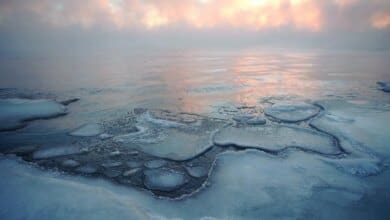
Musim dingin membawa musim yang lebih dingin dan lebih penting ke Great Lakes, terutama Danau Erie, yang melihat penutup es yang hampir lengkap pada bulan Februari. Saat musim semi mendekat, danau itu mengungkapkan perairan dinamis yang diisi dengan sedimen yang berputar -putar dan mekar diatom yang semarak, ganggang mikroskopis yang berkembang bahkan di bawah es.
Para ilmuwan yang mempelajari organisme ini menemukan bahwa mereka tidak hanya membantu membersihkan air tetapi juga menopang jaring makanan air selama bulan -bulan yang lebih dingin. Strategi kelangsungan hidup mereka yang cerdas melibatkan bekerja sama dengan bakteri untuk melekat pada es dan fotosintesis dalam cahaya rendah. Mekar di bawah es ini menawarkan wawasan baru tentang ekologi musim dingin danau, pernah dianggap sebagai musim yang tidak aktif.
Musim Dingin 2024-2025 membawa lebih banyak es
Musim Dingin 2024–2025 membawa salju yang pahit dan sering berdekatan ke daerah Great Lakes, membuat kehadirannya terasa. Penutup es melintasi danau yang melonjak di atas rata -rata pada bulan Februari. Meskipun tingkat es sebagian besar tetap di bawah rata -rata untuk sisa musim ini, mereka jauh lebih dekat dengan kondisi khas daripada es minimal yang terlihat selama dua musim dingin sebelumnya.
Danau Erie, yang paling dangkal dari Great Lakes, mencapai cakupan es 95 persen pada Februari 2025, tepat sejalan dengan norma musiman. Saat musim semi mendekat, es secara bertahap surut, mengungkap tanda -tanda kehidupan di permukaan danau.
Landsat 8 menangkap perairan musim semi yang berputar -putar
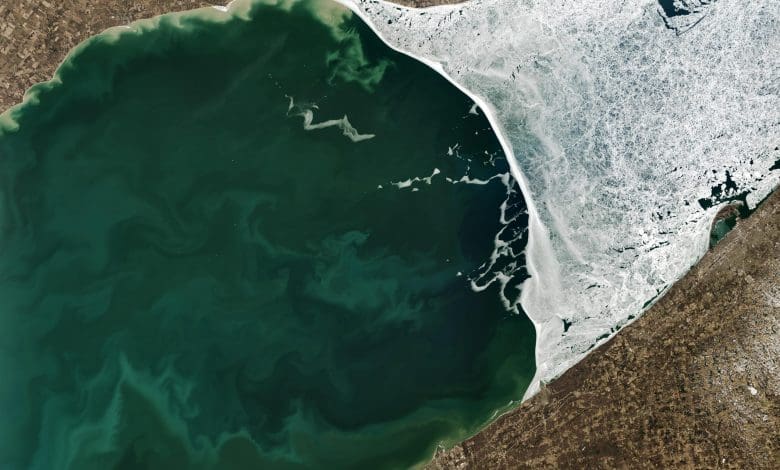
Pada 10 Maret, Operasional Land Imager (OLI) ON[{” attribute=”” tabindex=”0″ role=”link”>NASA’s Landsat 8 captured the image above of central Lake Erie. At the time, ice covered about 33 percent of the lake. The exposed water revealed swirling bands of sediment and phytoplankton, hinting at growing biological activity.
Resuspended sediment often produces colorful patterns in Lake Erie’s surface waters, especially in spring. Strong winds and the currents they generate can stir up material from the shallow lakebed. The lake bottom is rich in quartz sand and silt, as well as calcium carbonate from limestone. A lot of resuspension was occurring at the time of this image, said Michael McKay, director of the Great Lakes Institute for Environmental Research at the University of Windsor, accounting for some of the color.
Diatoms Add a Biological Tint
At the same time, McKay added, elevated levels of a type of phytoplankton called diatoms were present. Communities of these microscopic organisms, which have silica shells and plenty of chlorophyll, may have contributed to the color of surface waters. Although Lake Erie, specifically its western basin, is a hotspot for harmful algal blooms in the summer, different phytoplankton groups can thrive in the lake other times of year.
Samples collected by a Canadian Coast Guard icebreaker on March 10 contained elevated chlorophyll concentrations indicative of a spring bloom and showed that diatoms made up 80 to 90 percent of the phytoplankton present, said McKay. The samples came from locations near the ice edge and extending west approximately 80 kilometers (50 miles), and the measurements corroborated those from samples collected by a U.S. Coast Guard icebreaker in Lake Erie’s central basin three days earlier.
Diatoms Thrive Even Beneath the Ice
Scientists discovered in the early 2000s that diatoms could live within and just below Lake Erie’s ice. As the main components of winter-spring blooms, these microbes play important roles in the lake ecosystem, including cleaning pollutants from water and forming the base of the aquatic food web.
Subsequent work has revealed their clever strategy for surviving harsh winter conditions. The diatoms have a symbiotic relationship with a type of bacteria that can form ice crystals. That relationship enables diatoms to attach to the underside of lake ice and access the light needed to perform photosynthesis. Sparser ice cover during some winters has resulted in lower abundance of some diatom species, researchers found, with implications for the lake ecosystem that are not yet fully understood.
A New Appreciation for Winter Ecology
“We spent decades ignoring this time of year,” said Steven Wilhelm, director of the Aquatic Microbial Ecology Research Group at the University of Tennessee. “[McKay and I] beruntung menjadi bagian dari tim yang memiliki kesempatan untuk mulai menyelidiki kembali Danau Erie di musim dingin sekitar 18 tahun yang lalu. ” Banyak pertanyaan seputar hubungan antara musim-bagaimana mekar diatom dapat membentuk onset dan keparahan mekar musim panas, misalnya-matang untuk penyelidikan lebih lanjut, katanya. “Jelas danau itu aktif dan hidup sepanjang tahun.”
Gambar NASA Earth Observatory oleh Michala Garrison, menggunakan data Landsat dari US Geological Survey.